Non-effective staging
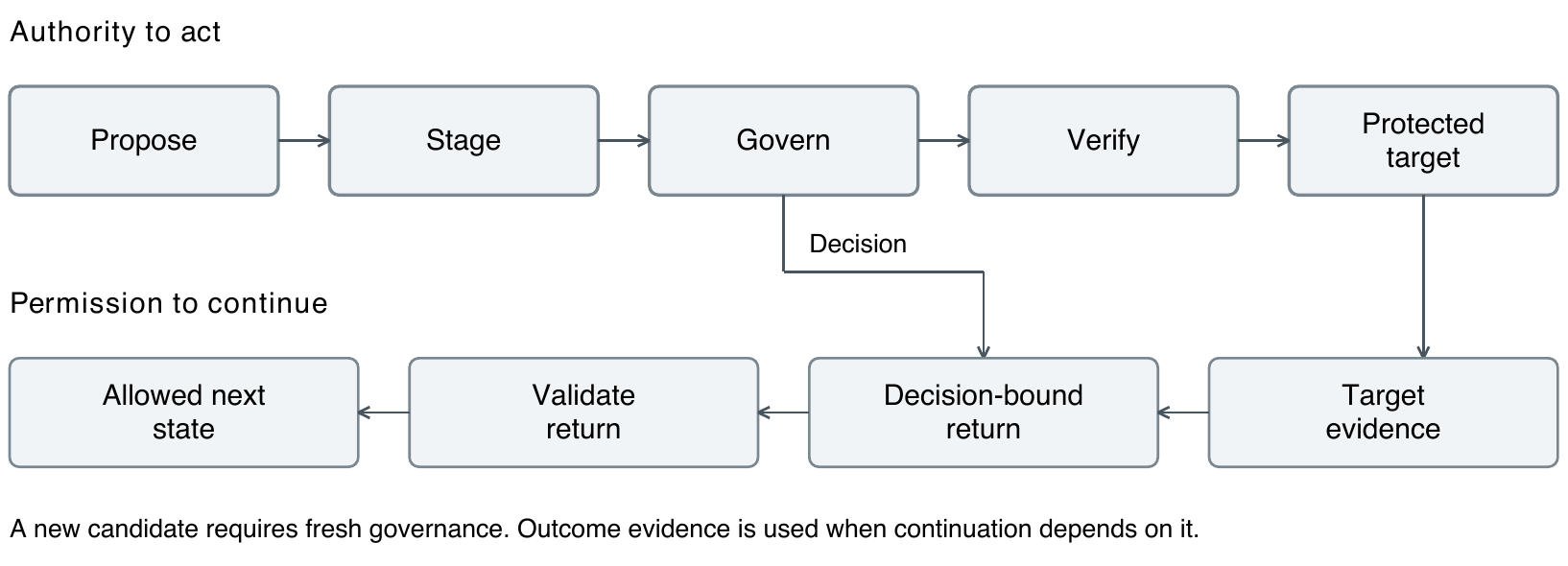
Generated outputs, tool calls, memory writes, and actuator commands remain inert while awaiting governance.
Pre-effectuation supervisory governance
An AI can propose a useful change without having permission to carry it out. 4Gate separates those powers and controls both the action and what the system may do next.
Current public paper: Version 7.4, with V29 development results and their limits. Written for engineers and interested nonspecialists.
Research collaboration · standards development · licensing · deployment
Execution may propose.
Governance may authorize.
Only the gate may permit effectuation.
The core mechanism
Proposals are held for review before a protected system accepts them. The final check confirms that permission still applies to the exact change. This requires control over every relevant route to the protected system; it does not guarantee that every approved decision is wise or safe.
Generated outputs, tool calls, memory writes, and actuator commands remain inert while awaiting governance.
A supervisory component evaluates the exact proposal in view of dynamic system state, context, and applicable constraints.
The enforcement gate positively verifies identity, scope, time, state, and replay conditions at attempted effectuation.

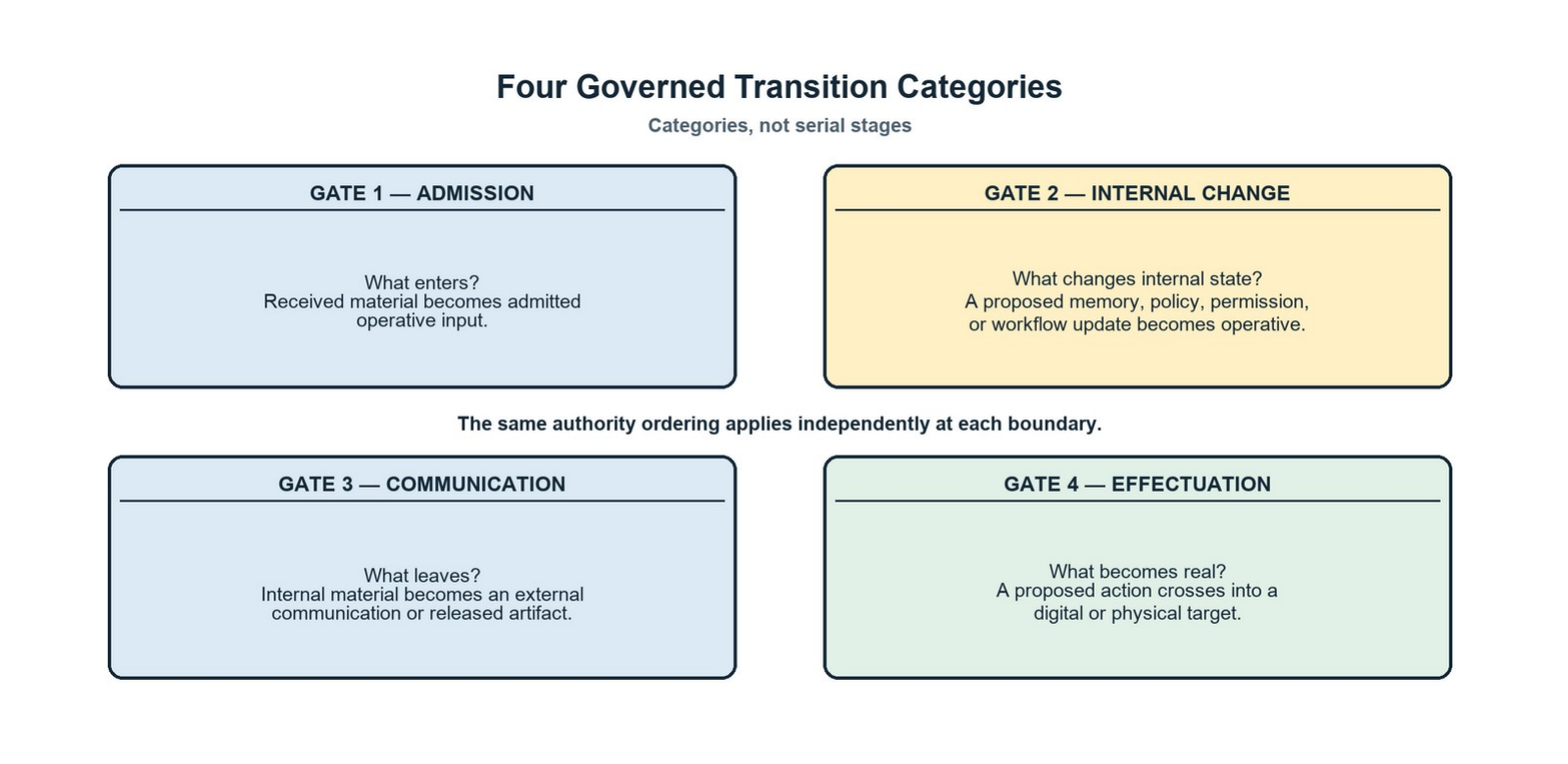
The four-transition stack
The four gates classify protected transitions. They may be implemented as separate or combined layers according to the system boundary and threat model.
Governs when external material becomes admitted system input.
Governs updates to continuing memory, configuration, policy, and workflow state.
Governs external-facing communications, messages, and data release.
Governs tool execution, digital transactions, and physical actuation.

What this makes possible
Does governing an AI system make it slower? A more useful question is whether governance can operate at the same speed as AI-generated development.
AI systems have become remarkably capable software engineers. Increasingly, they can develop and optimize the low-level kernels that translate an application's particular workloads into efficient execution on specialized hardware.
Google provided an early public indication of this trend when it reported that AlphaEvolve had optimized low-level kernels and proposed a circuit modification incorporated into a future TPU. OpenAI subsequently provided another especially concrete demonstration with Jalapeño—a purpose-built inference processor developed with Broadcom, with Codex used to generate and rapidly optimize low-level kernels for the hardware.
OpenAI reports that Codex helped bring three previously unplanned models to high performance on its Jalapeño inference chip within two months. For selected model blocks, AI-generated implementations ran 1.5 to 1.8 times faster than existing human-expert implementations.
SemiAnalysis describes specialized kernels supported by automated correctness checks, sanitization, simulation, tracing, and benchmarking. At that pace, reviewing every generated line by hand cannot be the only control.
4Gate allows capable systems to keep generating and optimizing while separating that capability from the authority to change an operative system. Each implementation remains a candidate until its identity, evidence, authorization, target, configuration, and current state have been verified.
If a better implementation appears, the controlled return path carries the evidence forward—but not the previous authorization. The successor is a fresh proposal for fresh governance.
Codex accelerates the factory. 4Gate governs what leaves it.
Jalapeño is presented as an external application example. This is not a claim that OpenAI uses or endorses 4Gate.
Public reader edition
Version 7.4 is the current public reader-facing edition. It explains the four boundaries and controlled return through everyday examples, including a software update whose outcome is uncertain. It also reports what changed in V29, what the development tests showed, and what remains unproven.
A nine-page introduction to separating the ability to propose from the authority to act. Defines technical terms, illustrates the forward and return paths, and explains the obligations a real deployment still has to meet.
Read or download Version 7.4 — PDF Download Version 7.4 directlyVersion 7.4 supersedes Version 7.3 as the public introduction. Qualified parties may request access to deeper technical materials under NDA.
Professional inquiries
Due to limited availability, 4Gate Systems may be unable to respond to general questions, unsolicited proposals, or requests for extended individual consultation.